

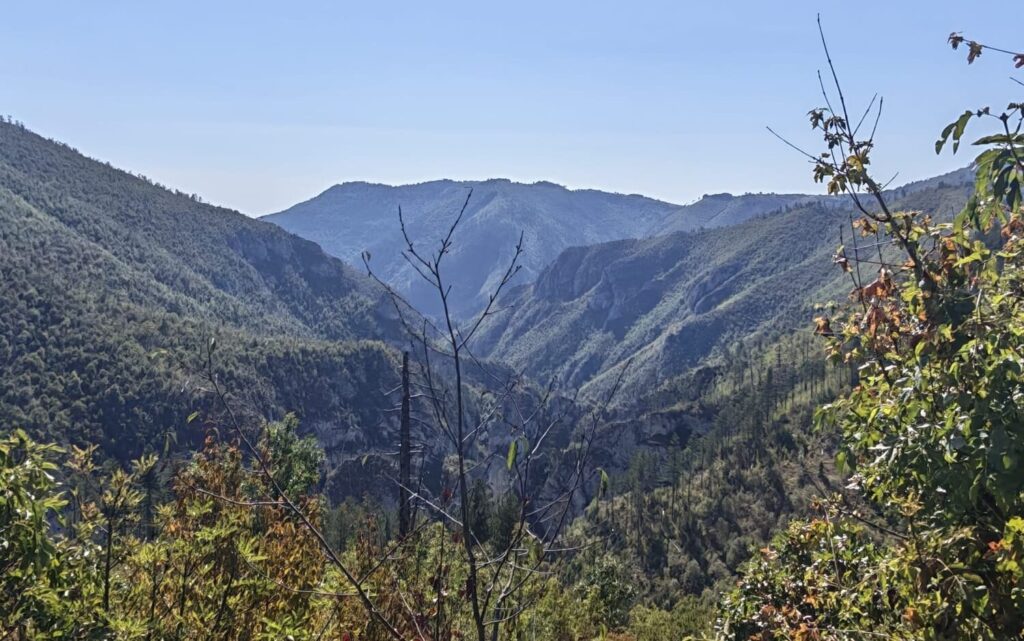
From Sklopovi, the landscape comes before the tree.
The Beli Rzav cuts through this part of Tara Mountain in western Serbia, creating steep slopes, exposed rock and forests that seem to occupy every surface capable of holding them. From a distance, the mountainsides appear almost continuously green. Look longer, and that continuity begins to break apart: cliffs interrupt the forest, shallow soils disappear between rocks, scrub occupies open ground, and individual conifers rise from places that seem to offer very little.
This is part of the natural world of Pančić spruce, or Picea omorika, one of the most distinctive endemic conifers of the Balkans.
Its present natural distribution is remarkably small, concentrated around the middle Drina region of western Serbia and eastern Bosnia and Herzegovina. Yet fossil evidence tells a very different story. The species, or its ancestral lineage, once had a much broader European distribution. Today Pančić spruce is both endemic and relict, and is often described as a “living fossil” of European and Balkan flora, a survivor of vegetation that was far more widespread millions of years ago.
At Tara, that long natural history intersects with a much more recent human one: the search of Josif Pančić for a tree he knew by name long before he finally stood beside it.
A tree known before it was found
Pančić first heard the name omorika while travelling through the Užice region in 1856. Local people knew the name, but finding someone who could actually lead the botanist to the tree proved considerably more difficult.
The search continued for almost two decades.
Then, in 1875, at Sklopovi near Zaovine, Pančić finally encountered the conifer he had been pursuing. The discovery introduced to science a species that would ultimately bear both the old local name and his own: Picea omorika (Pančić) Purk. Serbian spruce is easy enough to describe in a flora. Understanding why it still exists requires looking beyond the tree and into the landscape around it.
A landscape of ecological extremes
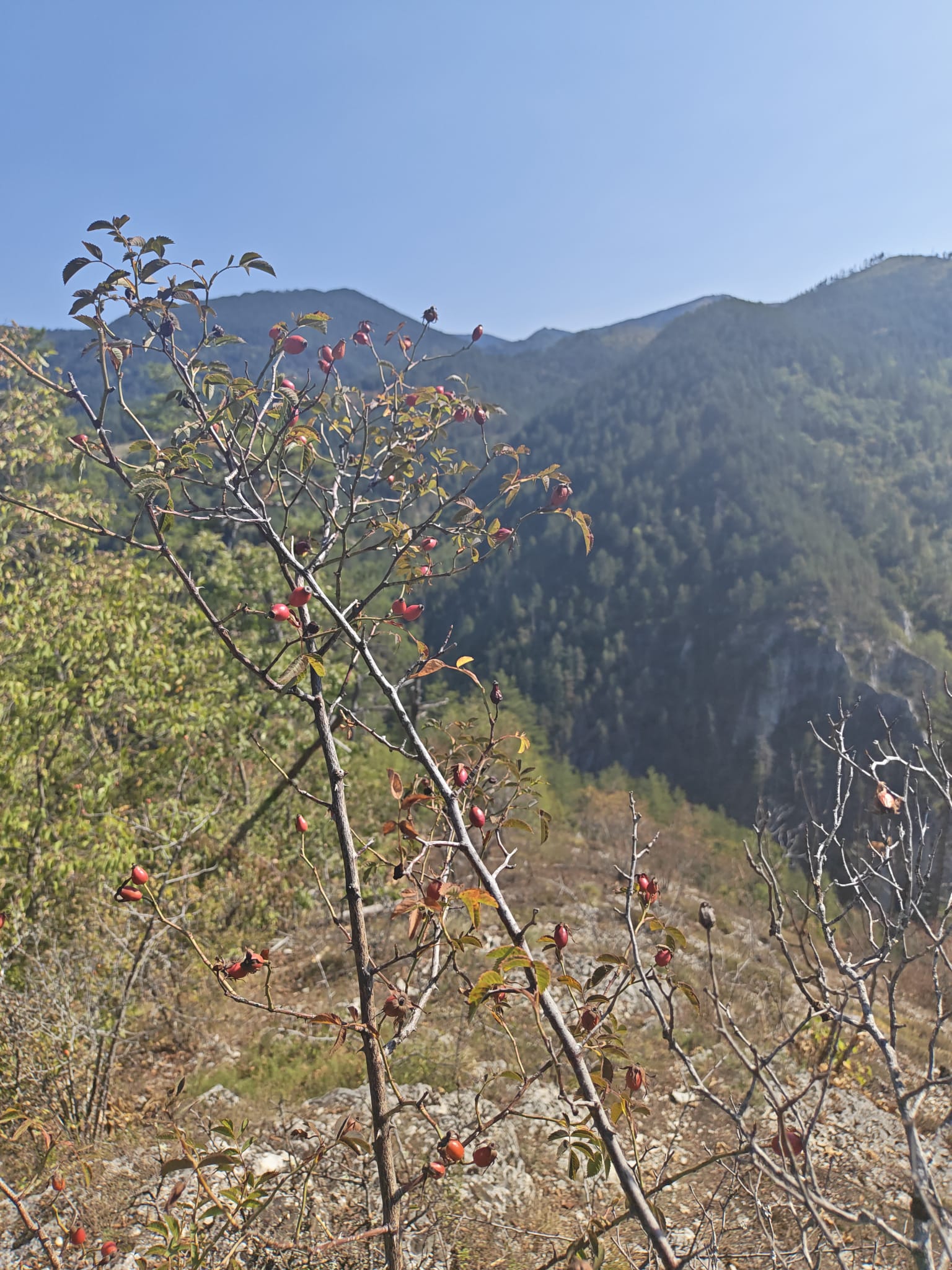
The rose hips in the foreground make the slope look generous with life. The ground beneath them tells another story.
Rock lies close to the surface. Soil occurs in shallow pockets. Exposure can be intense, and water availability can change rapidly across very short distances.
Much of the natural habitat of Pančić spruce has this character. On Tara, populations commonly occur on thin, rocky soils, particularly over limestone, although the species is not restricted to limestone alone. Some populations also grow over serpentinite, a magnesium-rich rock that produces chemically unusual and often nutrient-poor soils. Recent research in Tara National Park records Serbian spruce populations on limestone, serpentinite and, exceptionally, peat.
Picea omorika usually doesn’t stand alone. Its forests can include Norway spruce (Picea abies), silver fir (Abies alba), European beech (Fagus sylvatica), Scots pine (Pinus sylvestris), Austrian pine (Pinus nigra) and several broadleaved species. Across Tara, its habitats occur through a substantial elevational range, roughly from the lower mountain slopes toward 1,600 metres.
These slopes may appear hostile, but they also change the rules of competition.
On deeper, more productive soils, faster-growing trees can form dense forest and compete strongly for light, water and space. A cliff, a shallow patch of soil or an exposed rocky slope removes some of that advantage. Conditions become harder for everyone.
For Serbian spruce, that can matter, an inhospitable landscape can become a refuge.
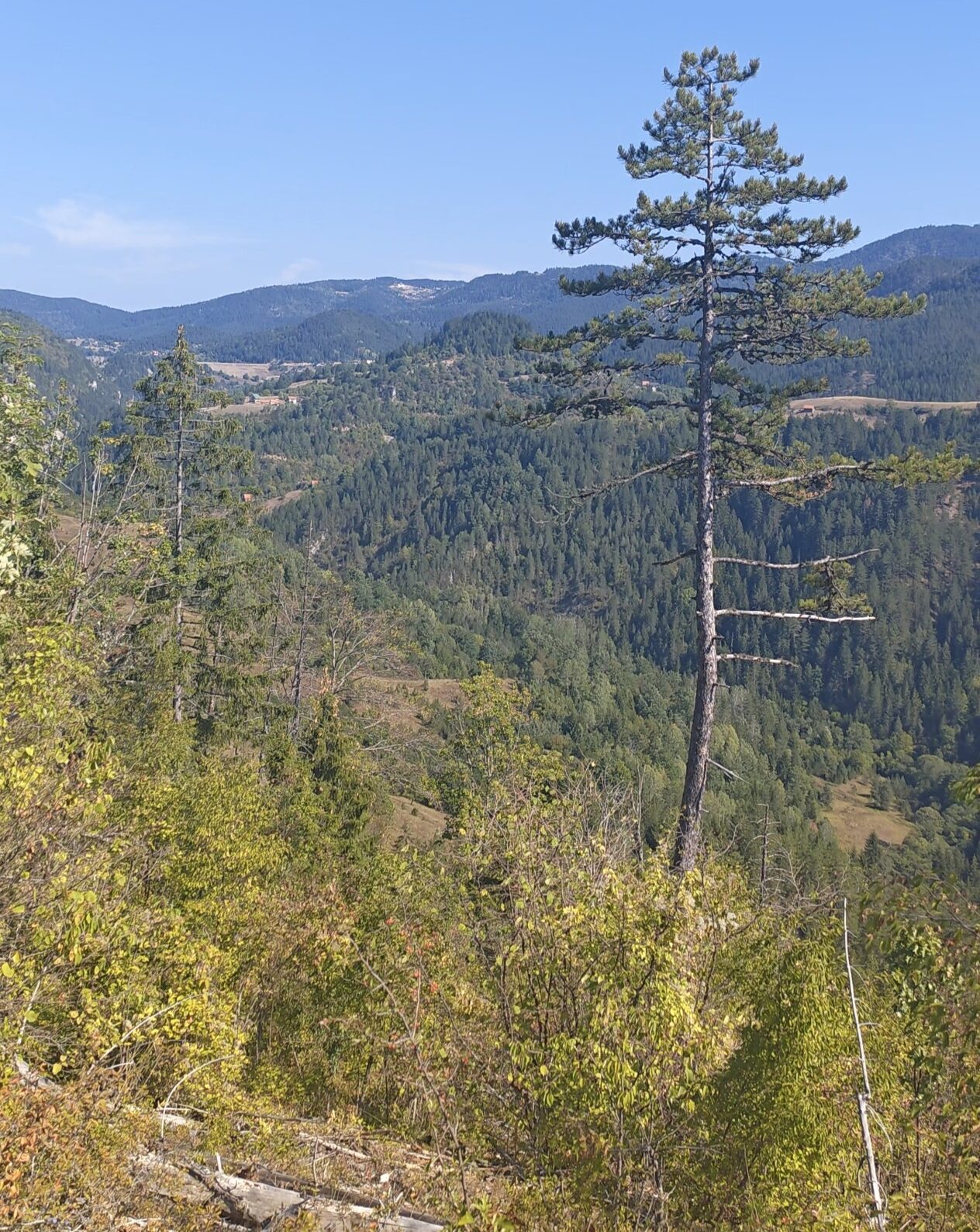
Viewed from the opposite side of a valley, a mountain slope can look like a single forest.
On foot, it resolves into dozens of smaller environments. Across this mosaic, subtle shifts in soil depth, canopy openness and competition help determine where Serbian spruce can establish and persist.
And water is becoming increasingly important within that equation.
A recent dendroclimatological study examined 231 Serbian spruce trees from 11 populations in Tara National Park. Summer water deficit emerged as the dominant climatic control on radial growth, while future climate scenarios projected substantial reductions in growth relative to historical conditions.
For a tree famous for survival, this creates an uncomfortable paradox: surviving past climatic change does not guarantee resilience to the speed and combination of pressures occurring now.
But Tara has another surprise.
An exception written in peat
Travel from the rocky landscapes around Zaovine toward Crveni potok near Mitrovac, and the ecological story changes almost completely.
The cliffs disappear. The ground flattens. Beneath the forest lies peat.
Here, Serbian spruce occurs naturally in a relict forest community associated with the peatland landscape of Crveni potok and Tepih livada. It is an extraordinary contrast to the steep limestone slopes so often associated with the species.
This is not a planted stand and not simply another cultivated group of Pančić spruces around Mitrovac. It is a natural population occupying an atypical substrate. Modern ecological work on Tara records peat alongside limestone and serpentinite among the substrates supporting surviving populations of P. omorika.
The locality also has its own chapter in the history of Serbian spruce research.
Decades after Pančić’s discovery at Sklopovi, Carlo Maly, curator of the National Museum in Sarajevo, investigated the species further. In 1934, using information obtained from forestry engineers working on Tara, he documented the remarkable Mitrovac locality on the peat deposits of Crveni potok.
The natural range of Pančić spruce is tiny, but within that small geographical space the species occupies surprisingly different ecological settings.
Restricted distribution, in other words, does not necessarily mean ecological simplicity.
The silhouette gives it away
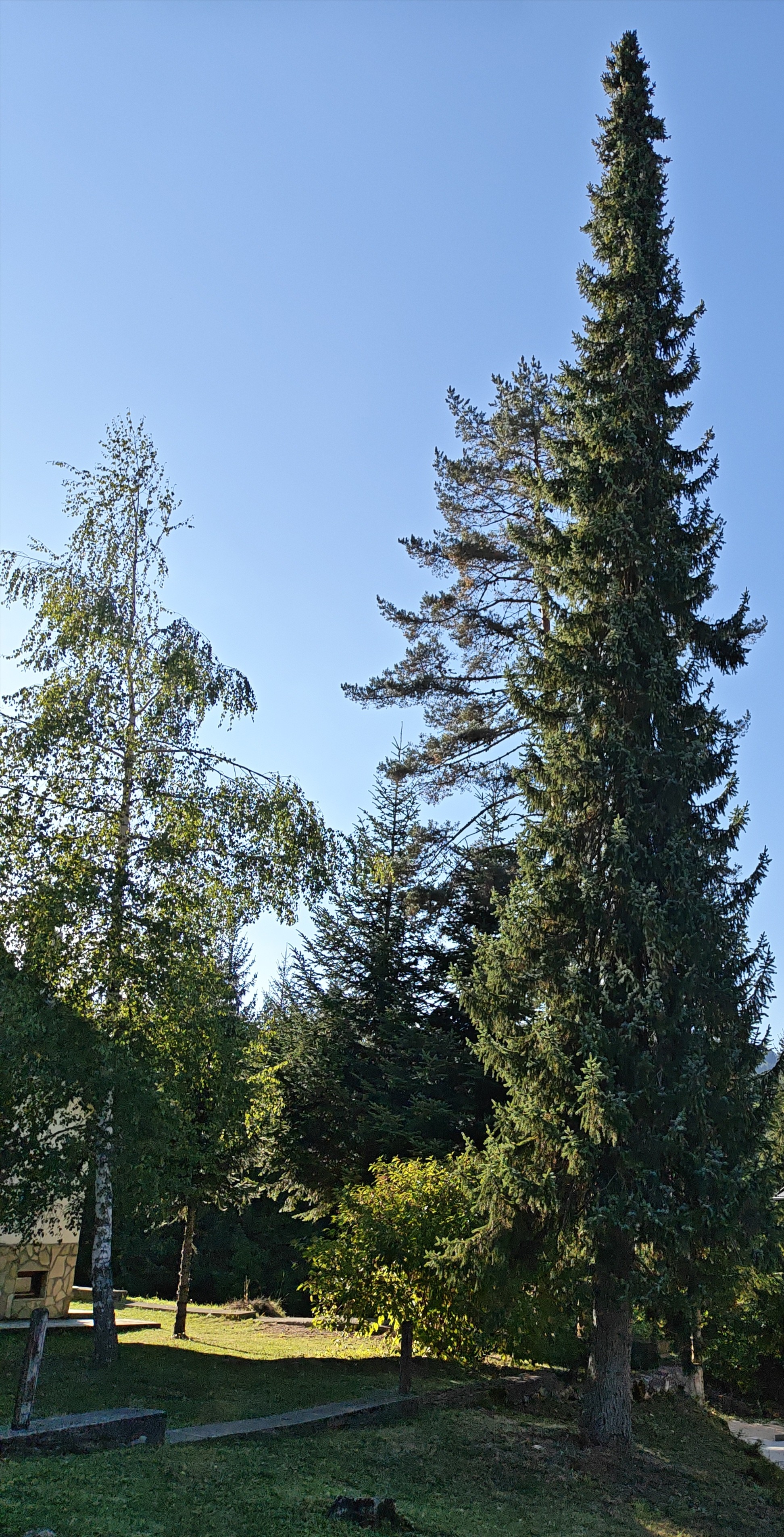
After Sklopovi and Crveni potok, encountering Pančić spruce beside a building feels almost incongruous.
But this is another part of its story.
The species has been cultivated far beyond its tiny natural range, and its architecture makes it difficult to mistake once you learn to recognise it. Mature trees develop an unusually narrow, columnar to narrowly pyramidal crown, with comparatively short branches and a remarkably slender silhouette. It is precisely this form that helped make the species attractive in cultivation.
A cultivated tree can therefore teach us something that the distant trees on a canyon wall cannot.
It lets us walk closer. Look closer.
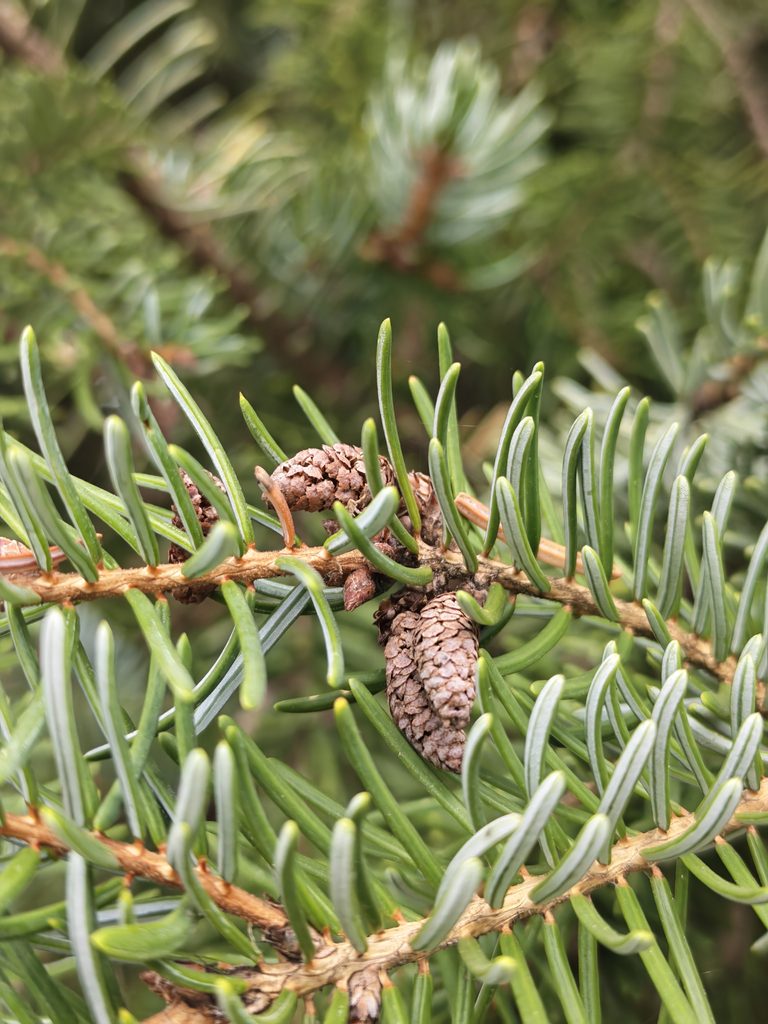
From a distance, Pančić spruce is recognised by its unusually narrow silhouette. Up close, the identification becomes more subtle.
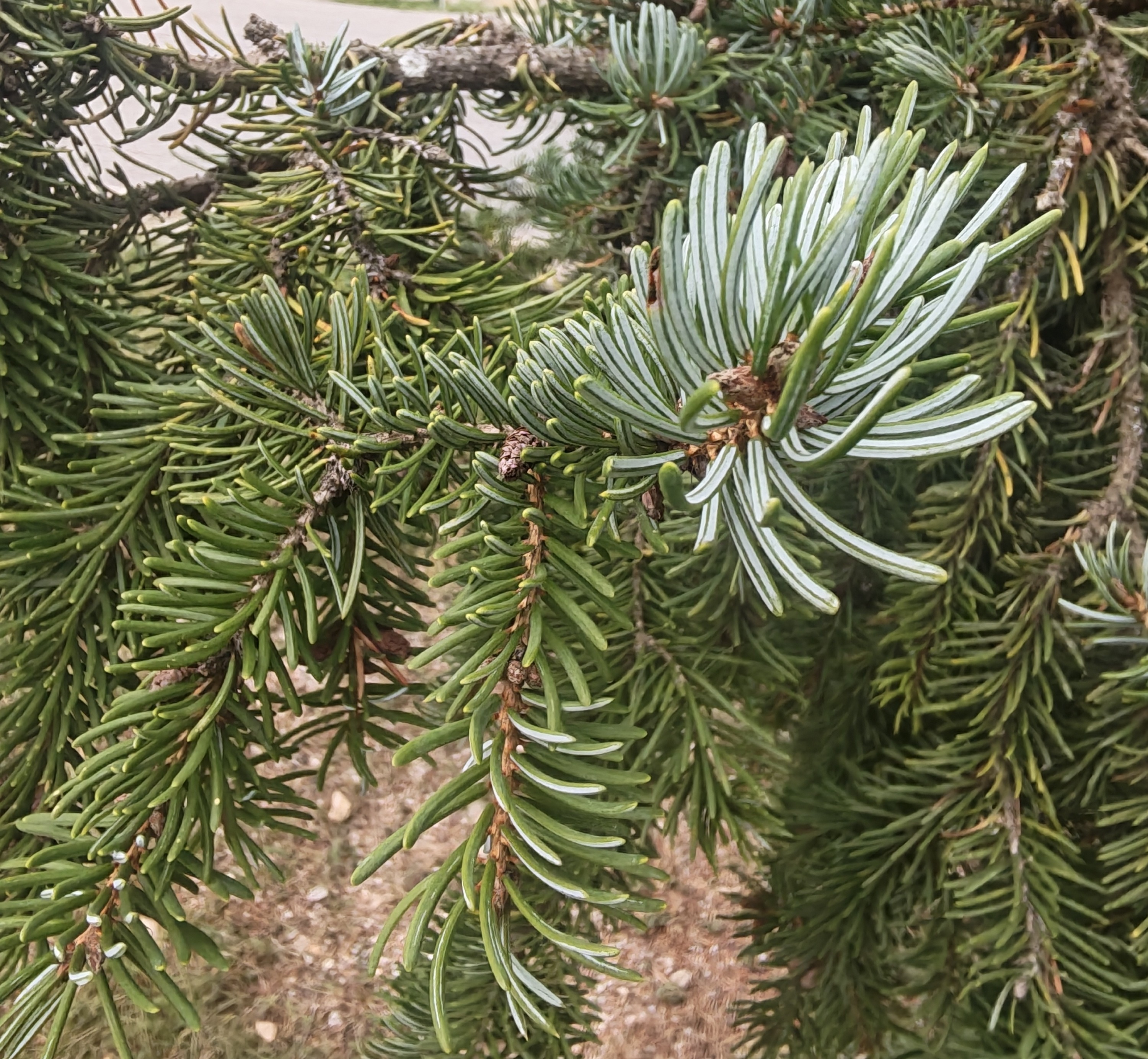
The needles are flattened and arranged densely along the shoots, with dark green upper surfaces and much paler undersides. As branches twist and needles sit at different angles, both surfaces become visible at once. This contrast gives Serbian spruce foliage its characteristic green-and-silver appearance, a feature that is much easier to appreciate at branch level than from across a forested slope.
The photograph also reveals how much information is hidden within a single branch. Needle orientation, colour, young shoots and reproductive structures all become part of the tree’s seasonal biology. What appears from a distance as a simple evergreen crown resolves, on closer inspection, into a much more intricate architecture.
That shift in scale mirrors the story of Picea omorika itself. From Sklopovi, we first encounter a landscape. At Crveni potok, an ecological exception. In cultivation, a distinctive silhouette. And finally, close enough to touch, the details that make Pančić spruce recognisable as an individual species.
Persistence is not permanence
Pančić spruce has survived an extraordinary amount of environmental change.
Its fossil history points toward a much wider European past, while its present populations survive within a narrow Balkan refugium. This combination of ancient lineage, restricted distribution and persistence through major climatic transitions is why Serbian spruce is often described as both a Tertiary relict and a living fossil.
But persistence should not be mistaken for security.
Picea omorika is currently classified as Endangered. Its fragmented natural populations face interacting pressures from climate, competition, regeneration dynamics, disturbance and the simple vulnerability that comes with occupying such a restricted natural range.
Sklopovi makes the species look almost improbable: a narrow conifer holding on among rock, forest and steep relief. Crveni potok makes the story more complicated: the same species persisting on wet peat in a landscape that appears to break the rules established only kilometres away.
Perhaps that is the more useful way to understand Pančić spruce.
Not simply as a rare tree, nor only as a living fossil, but as the product of relationships between geology, water, climate, competition, disturbance and time.
More than 150 years have passed since Pančić first encountered the tree at Sklopovi. Pančić spruce is still holding on, in landscapes that continue to shape both its survival and its future.
References
- Kazimirović, M. & Stajić, B. (2025). Potential effects of climate change on growth and conservation of Serbian spruce. Forest Ecosystems, 12, 100287.
- Popović, Z. et al. (2025). Refugial habitats of paleoendemic Picea omorika: Soil and plant attributes. Science of the Total Environment, 1001, 180498.
- Nacionalni park Tara. Biljni svet: Pančićeva omorika and natural habitats.
- Royal Botanic Gardens, Kew. Picea omorika. Plants of the World Online.
- Earle, C. J. Picea omorika (Serbian spruce). The Gymnosperm Database.
- IUCN. Picea omorika. The IUCN Red List of Threatened Species.
A remarkable species, shaped as much by its landscape as by its own biology. Fascinating to see how different habitats tell different parts of the same story.