

Beneath the Surface
Spring rarely arrives all at once.
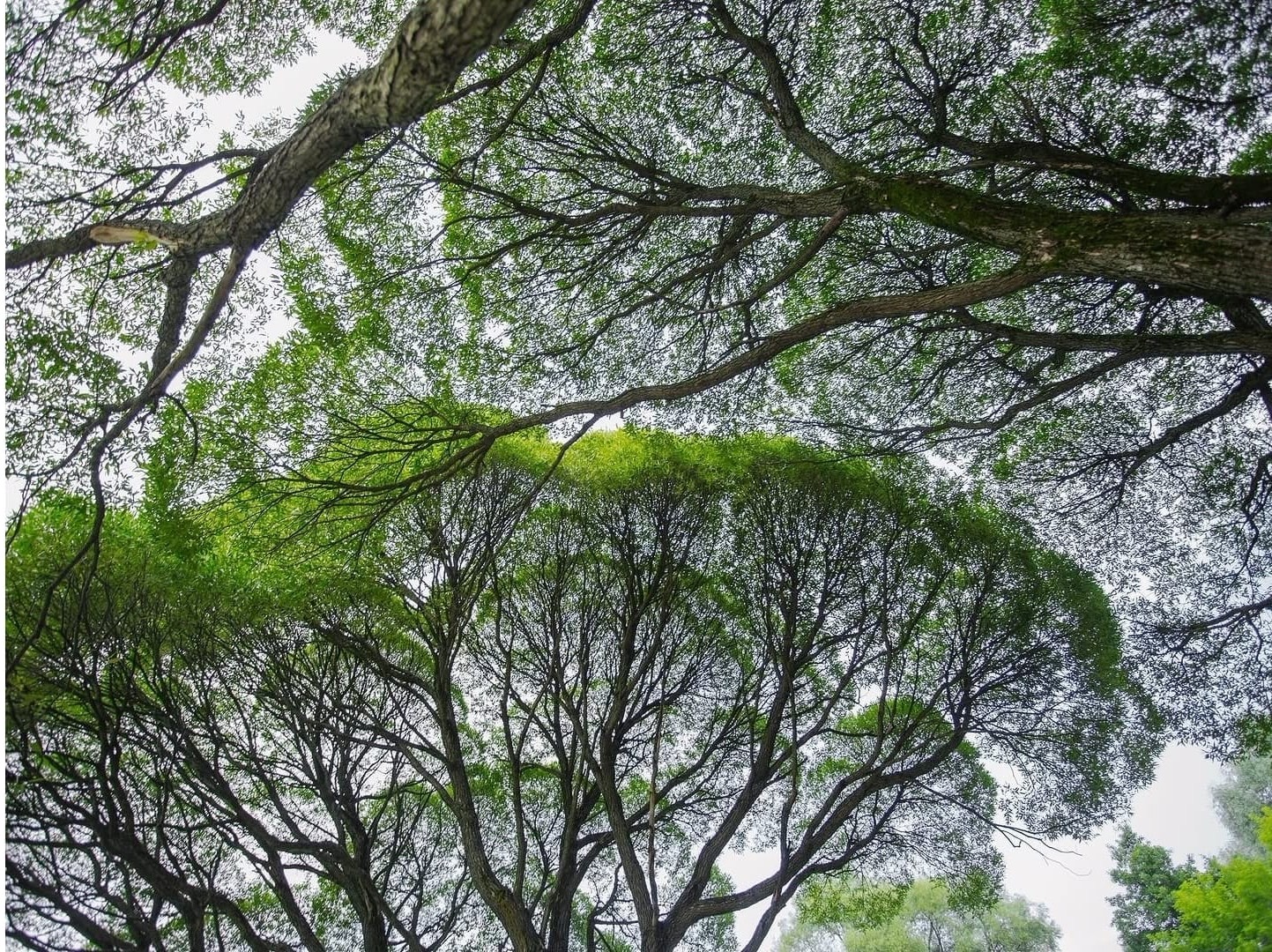
At first, the changes are subtle. Light lasts a little longer through the trees. The ground softens after rain. Moss begins to hold moisture again, and fallen wood darkens as the forest slowly shifts from stillness to movement.
Most of this transformation begins out of sight.
Beneath the soil, hidden from view, fungal networks are already at work, long before the forest appears fully awake above ground. Fine threads of mycelium move through decomposing wood, roots and organic matter linking them into a living web of exchange.
What appears above ground as a collection of separate plants and trees is, below the surface, often part of a much larger biological system.
Nothing in a forest grows entirely alone.
Networks of Exchange
After rainfall, some of these hidden processes briefly become visible.
A piece of bark lifted from damp wood may reveal thin white filaments spreading through the surface below. Pale cup fungi emerge from decomposing branches. Moss, insects, bacteria and fungal growth begin occupying the same space in shifting layers of activity.
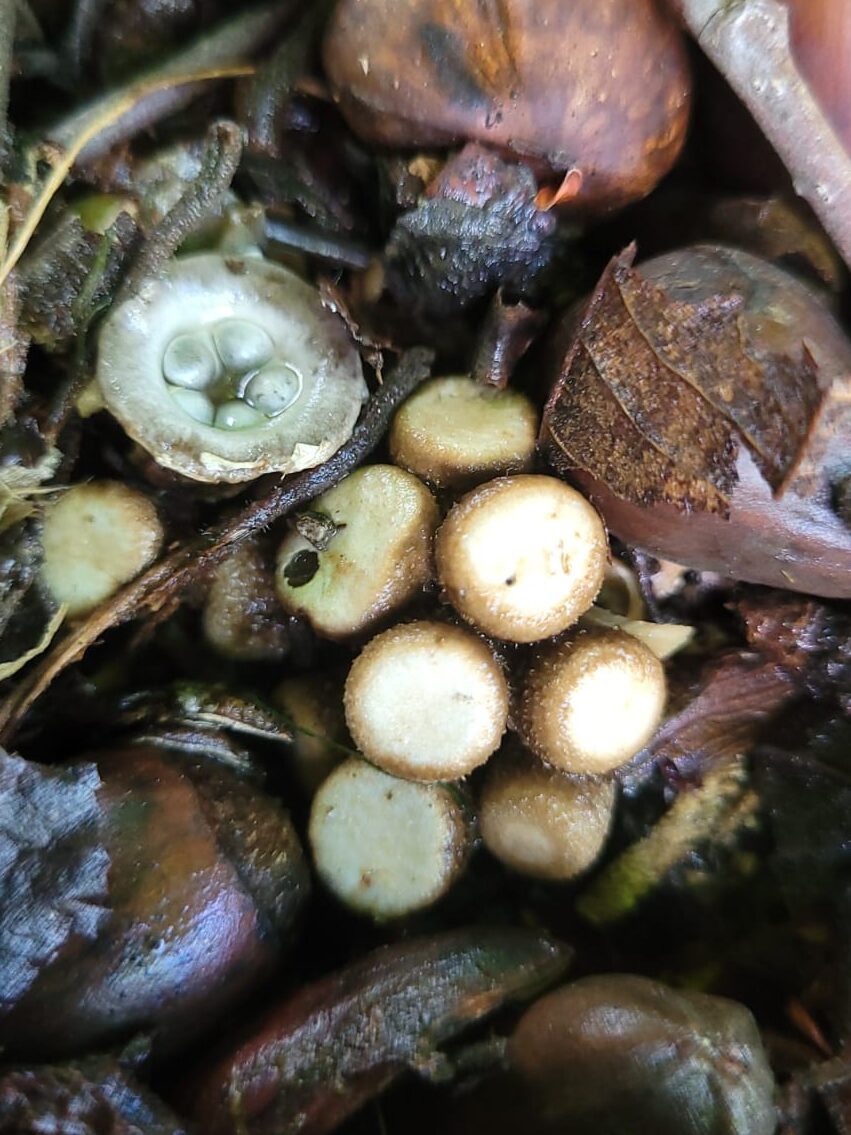
These are not isolated events. They are signs of exchange already in progress.
Many fungi form mycorrhizal relationships with plants, connecting with root systems below ground. Through these relationships, water, nutrients and chemical signals move across ecosystems in ways that influence growth, stress response and adaptation.
A tree growing in stronger light may supply carbon to connected neighbors in shade.
Roots under environmental stress can trigger chemical responses in surrounding plants.
Minerals and moisture move through underground networks that help stabilize changing conditions.
This does not mean that forests are harmonious in any simplistic sense. Competition still exists. So do limitation, pressure and change. But fungal networks show that ecosystems are not built on competition alone. They are also shaped by cooperation, response and exchange.
In that sense, fungi are not just decomposers or passive symbionts. They are active participants in how living systems hold together.
Beyond the Individual
Seen closely, the forest challenges the idea of complete independence in nature.
A tree does not exist as a sealed unit separated from its surroundings. Its survival depends on continuous interaction with fungi, microbes, moisture, soil composition, temperature and neighboring organisms. What appears to be a single organism is, in reality, part of a wider network of relationships.
Field observation makes this easier to understand. Over time, patterns begin to emerge that are difficult to notice at first glance. Certain fungal species appear only under specific moisture conditions. Some emerge alongside particular trees or stages of decay. Others disappear entirely as temperature, light and soil composition shift through the season.
At first, these systems can seem chaotic.
With repeated observation, they begin to read differently.
The forest makes this visible in a quiet but profound way. Life is not simply arranged side by side. It is woven together through systems of connection that blur the boundary between the individual and the whole.
Field Observation and Living Systems
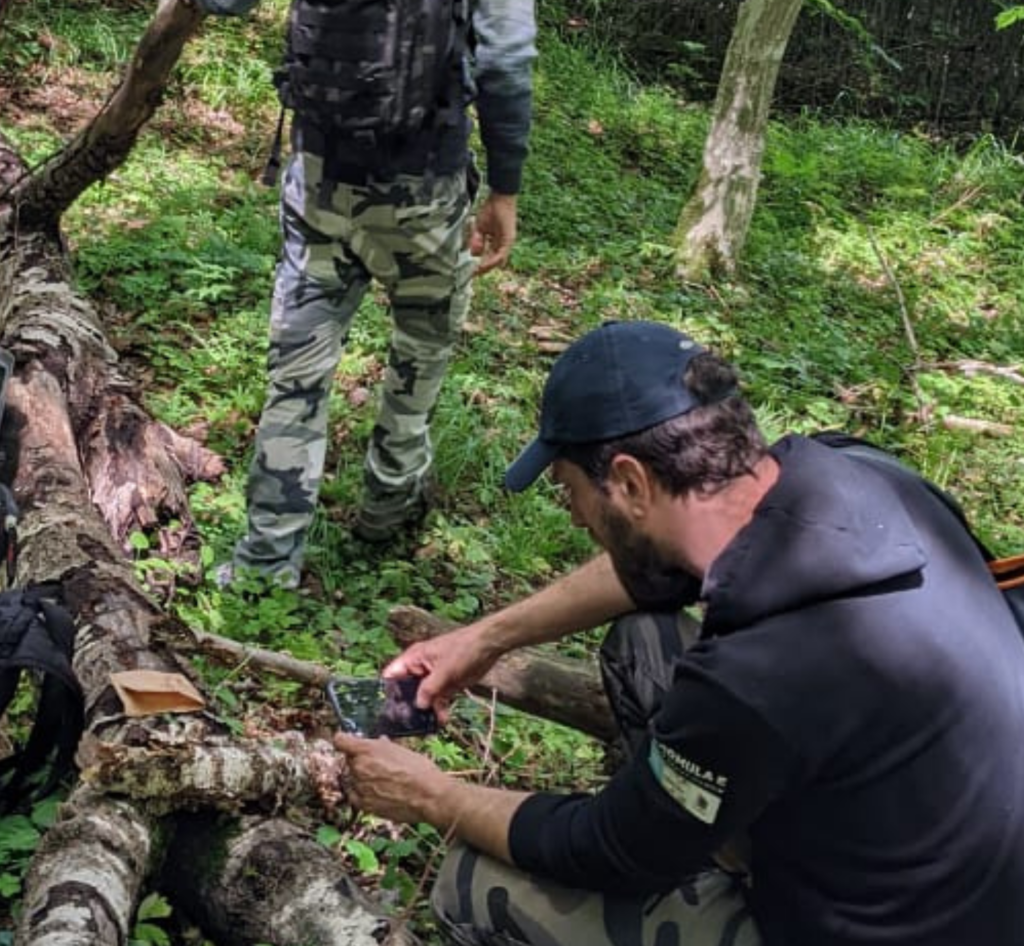
Studying fungal networks requires more than isolated observation or laboratory analysis alone. These systems are shaped by real environmental conditions – rainfall, soil disturbance, biodiversity, seasonal cycles and long-term ecological change.
This is where fieldwork becomes essential.
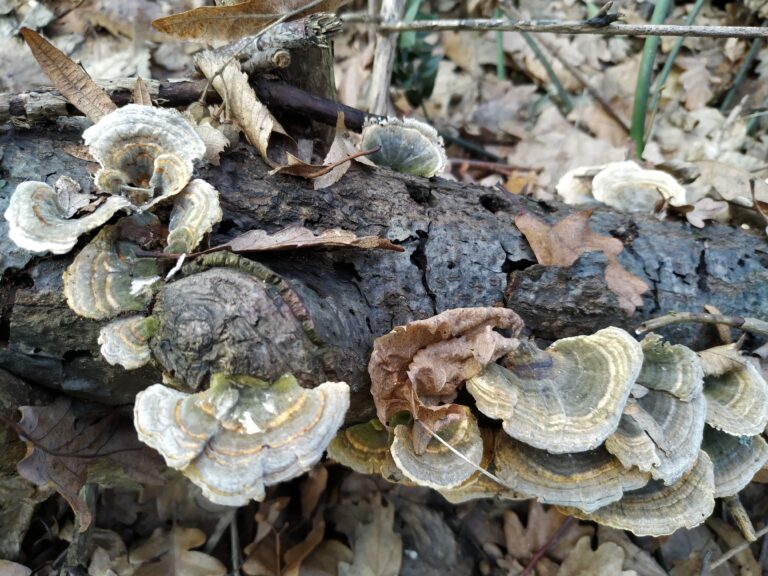
In living environments, small details often reveal larger processes. A fallen log is not simply dead material. It becomes habitat, nutrient source, moisture reservoir and site of biological transformation at the same time. Fungi break down lignin and cellulose, insects redistribute organic matter, and microorganisms continue cycles of decomposition beneath the visible surface.
The forest is not static scenery.
It is continuous biological activity.
Fungal networks are part of what allows these environments to remain adaptable despite constant change. Their structure is decentralized, responsive and distributed across entire ecosystems rather than controlled from a single point.
Resilience in nature often works this way.
Not through rigidity, but through interaction.
Lessons from the Underworld
Fungal networks matter not only because they are biologically fascinating, but because they reveal something larger about how living systems function.
They show that resilience does not always come from control. Stability does not always depend on central direction. In many cases, systems remain strong precisely because they are responsive, distributed and interconnected.
Exchange is not an accessory to these systems. It is part of their structure.
Adaptation is not a final outcome. It is an ongoing process.
Connection is not decorative. It is functional.
For that reason, fungal networks offer more than a subject of scientific study. They provide a living example of how complexity can remain coherent without becoming rigid, and how interdependence can be a source of strength rather than weakness.
From Observation to Application
These underground systems matter not only because they are biologically fascinating, but because they influence how we approach cultivation, environmental design and material research.
In agriculture and horticulture, fungal relationships can affect soil structure, nutrient availability and plant resilience. In biotechnology and biomaterials research, mycelium is increasingly explored as a renewable material capable of replacing resource-intensive production methods.
But the significance of fungal networks extends beyond practical application alone.
They encourage a different way of understanding living systems — not as isolated parts operating independently, but as environments shaped through constant exchange between organisms, conditions and time.
The network is not simply an object of study.
It is also a model for understanding how complex systems remain functional.
A Mycotopia Perspective
At Mycotopia, fungi are approached not as isolated curiosities, but as entry points into wider ecological and biological systems.
Field observation, research and interdisciplinary exploration all begin from the same premise: that many of the processes shaping life remain partially hidden until we learn how to look more carefully.
Fungal networks make those hidden relationships visible.
They reveal how organisms adapt together, how environments maintain balance through exchange, and how biological systems remain dynamic rather than fixed. Through mycology, ecology and applied research, these networks offer a way to better understand not only fungi themselves, but the structures that support life across entire ecosystems. This is grounded in the belief that life is best understood not as a set of separate parts, but as a network of relationships in constant exchange.
Looking Beneath
To walk through a forest is to notice texture, color, moisture and growth.
To look beneath the surface is to encounter something else entirely: a living network in continuous exchange.
Hidden below the forest floor are networks that redistribute nutrients, support biodiversity and shape the conditions for life above ground. They remind us that much of what matters most is not always immediately visible.
What appears separate is often connected.
What seems still is often active.
What looks isolated may already be part of something larger.
To study fungi is not only to observe organisms.
It is to rethink how life itself is organized.
[…] Like many woodland species, wild garlic is rooted in living ecosystems shaped by decomposition, nutrient cycling and the countless biological interactions unfolding beneath the forest floor – processes explored further in Hidden Forests, Hidden Networks. […]